· 5 min read
Why your company’s immune system will turn against you!

There are books that you download, flick through briefly, then put to one side. And there are books that change the way you look at your own organization. *Exponential Organizations* by Salim Ismail (external link, opens in a new tab)For me, that falls into the second category.
The central thesis: New, exponentially growing organizations are ten times better, faster and cheaper than established companies – not because they are smarter, but because they are structured differently. They utilise technologies and organizational principles that linearly growing structures are structurally unable to keep up with.
The phrase that sticks in your mind
Ismail sums up a thought that has stayed with me ever since: anyone driving genuine disruptive innovation within a large, established organization must be prepared for that the company’s immune system reacts – …with resistance, not with applause.
This is not a criticism of large companies. It is a sober observation of how organizations function. Processes, control mechanisms, approval rounds – all of this exists for good reasons. But it is precisely these reasons that make genuine disruption from within is so difficult.
Why this concerns me as a leader
For me, the key question is not ‘How do I protect my business from disruption?’, but rather: as a leader, how do I create spaces where new ideas are not immediately attacked by the organization’s ‘immune system’? This is a question of culture, not of a strategy slide.
Three insights from the book that I’m taking on board for my own day-to-day management work:
Clear objectives rather than rigid plans. Exponential organizations operate on the basis of a "Massive Transformative Purpose" – a grand, ambitious goal that provides direction without prescribing the path to it in detail. This allows teams to experiment quickly, rather than waiting for the next approval process.
Make use of external resources rather than trying to own everything yourself. Community, platforms, external talent – exponential organizations rely less on ownership and more on access. For established companies, this presents a real thought experiment: what do we really need to control ourselves, and where is smart access sufficient?
Algorithms and data as management tools. Not as an end in itself, but because data-driven decisions are faster and often more accurate than judgements based purely on experience – particularly in an environment that is changing faster than experience alone can keep up with.
An overview of the ten attributes
Ismail summarises his observations in ten specific characteristics, which he organises around the Massive Transformative Purpose (MTP) grouped around – five ‘external’ Attributes (SCALE), which organisations use to tap into external resources, and five ‘internal’ Attributes (IDEAS), which enable them to learn and act quickly.
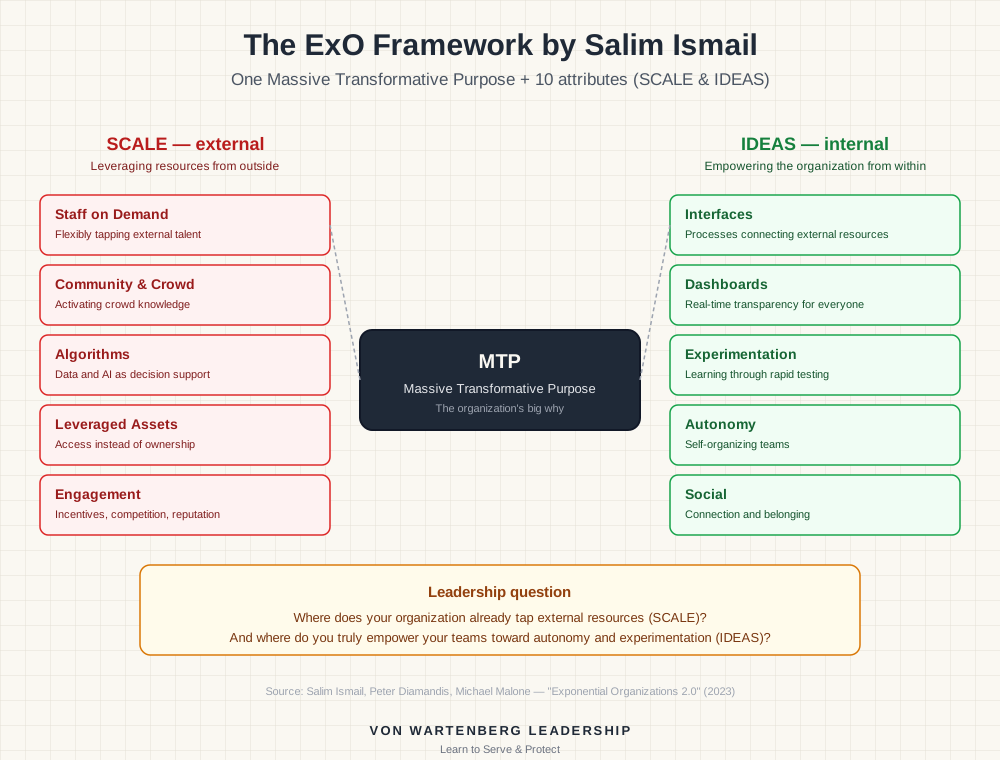
What strikes me is this: the external attributes (SCALE) often receive the most attention in the discussion – platforms, communities, data. In my view, however, the internal attributes (IDEAS) are the real leadership challenge. Autonomy and a willingness to experiment do not arise from a tool, but from the culture that a manager exemplifies on a daily basis.
German edition and new edition
For those who prefer to read in German: the book has been published under the title *Exponential Organizations: The Design Principle for Transforming Businesses in the Information Age*, translated by Mike Kauschke.
👉 Exponential organisations at Amazon (external link, opens in a new tab)
A note on this: The original English-language edition is now in its second edition – *Exponential Organizations 2.0 – The New Playbook for 10x Growth and Impact*, which Ismail co-authored with Peter Diamandis (external link, opens in a new tab) written by Michael Malone, with a foreword by Ray Kurzweil. It builds on eight years of further ExO practice and expands the framework to include recent case studies, including one on Use of AI. I am not currently aware of a German translation of 2.0.
My reading recommendation
If you’re in a leadership role and regularly feel that good ideas aren’t progressing as quickly as they should within your own organization – then this book is well worth reading, whether it’s the original or a new edition. Not as a blueprint to copy, but as food for thought on where your own ‘immune system’ might be overactive.
You can get a brief glimpse of it in this two Ted Talks of Salim:
Clicking “Load video” establishes a connection to YouTube (in privacy-friendly mode). Data may be transmitted to the provider - see our privacy policy.
Clicking “Load video” establishes a connection to YouTube (in privacy-friendly mode). Data may be transmitted to the provider - see our privacy policy.
I would also recommend ‘The Future Is Faster Than You Think’ by Peter Diamandis and Steven Kotler as a complementary read – it ties in seamlessly with this topic and shows how converging technologies are transforming industries and our lives.
Clicking “Load video” establishes a connection to YouTube (in privacy-friendly mode). Data may be transmitted to the provider - see our privacy policy.
Personal Note
Before the pandemic, I gave keynote speeches on digital transformation — and how it would change our lives. Immediately after the pandemic, inspired by Salim Ismail, these evolved into keynotes on exponential technologies and how we, as exponential organizations, should respond to them. At the time, I thought that was still about ten years in the future.
Today, just five years later, it’s clear to me: With AI tools like ChatGPT and Claude, we’ve long been living in this world. And it’s going to transform us all dramatically, whether we like it or not.
This wave—some would say this tsunami—will either sweep us away. Or we’ll grab a surfboard and learn to ride it.
Thanks to my LinkedIn contact Simon Nopp (external link, opens in a new tab), an experienced consultant in the field of exponential organizations, who first introduced me to many of these ideas.
Do you have any thoughts or comments? I’d love to hear them. Please head over to the LinkendIn Post (external link, opens in a new tab).. Or drop me a message via the contact page (external link, opens in a new tab).
I’d be delighted to discuss these topics with you.
Dr. Peter von Wartenberg (06.22)
----------------------------------------------------------
Learn to Serve & Protect – Leading My Business